

Aegis framework
Multi-agent AI for antimicrobial-resistance research. I led the three-person team that won Best Patient Impact at the GSK × IE Biopharma & AI Gateway.
Case and evidence
A guided five-step wizard turns a tuberculosis case into structured data: pathogen lab results, host profile, care setting and regimen. Each agent also gets evidence: a live Europe PMC literature search (trusted hosts, links checked) plus files the scientist uploads. All demo data is synthetic.
Four specialist agents
Pathogen, Host and Environment agents run in parallel, each with its own prompt and output schema. The Intervention agent then reads their merged findings and recommends a regimen with a resistance outlook.
Four providers, strict JSON
Each agent runs at the same time on OpenAI, Anthropic, Google Gemini and Ollama Cloud. Every answer must pass a strict JSON schema; if it fails, the validation errors become a repair prompt and the call is retried, up to three attempts.
GPT-4o synthesis
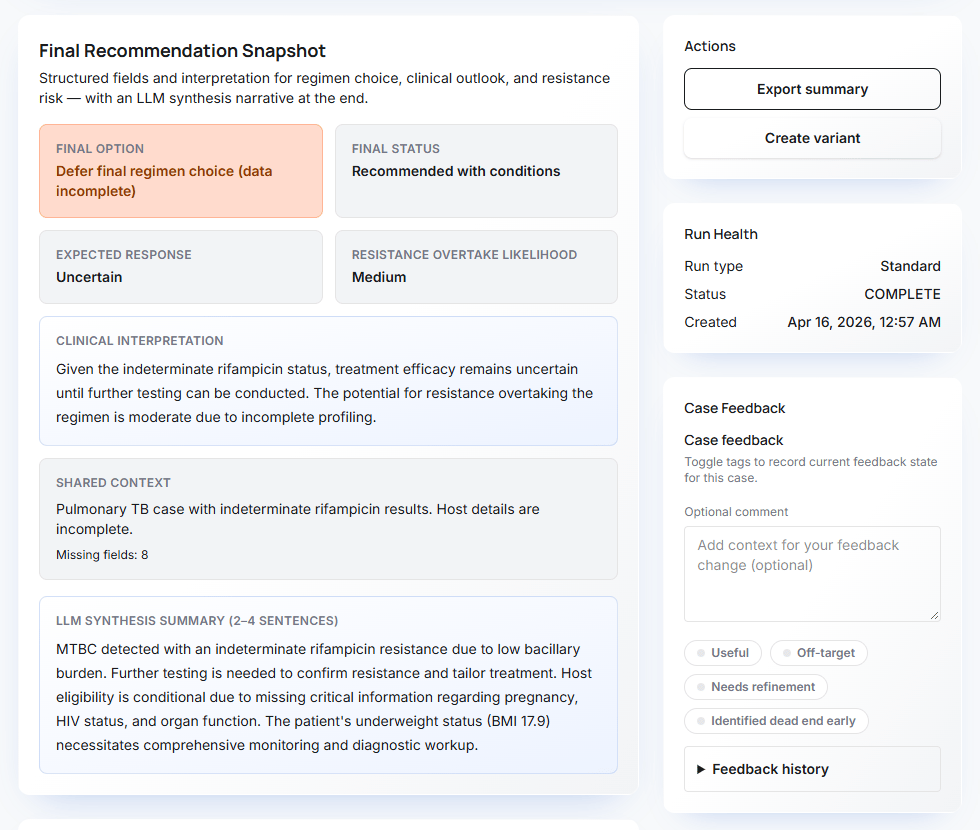
GPT-4o merges the provider answers for each agent into one, keeping the agreements, the disagreements and the open questions, with a confidence rationale. The cross-check comes from several models answering the same question.
Auditable case
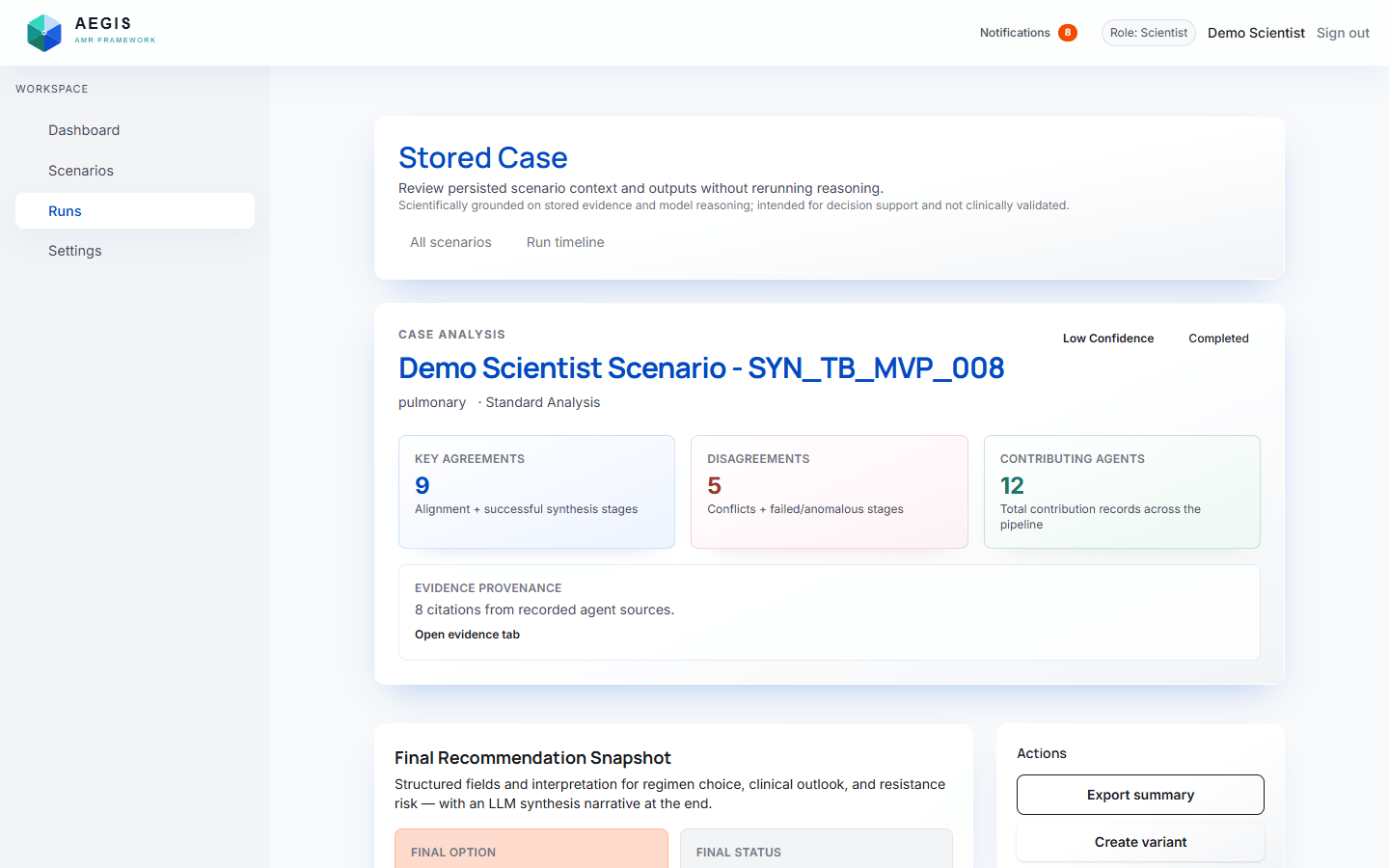
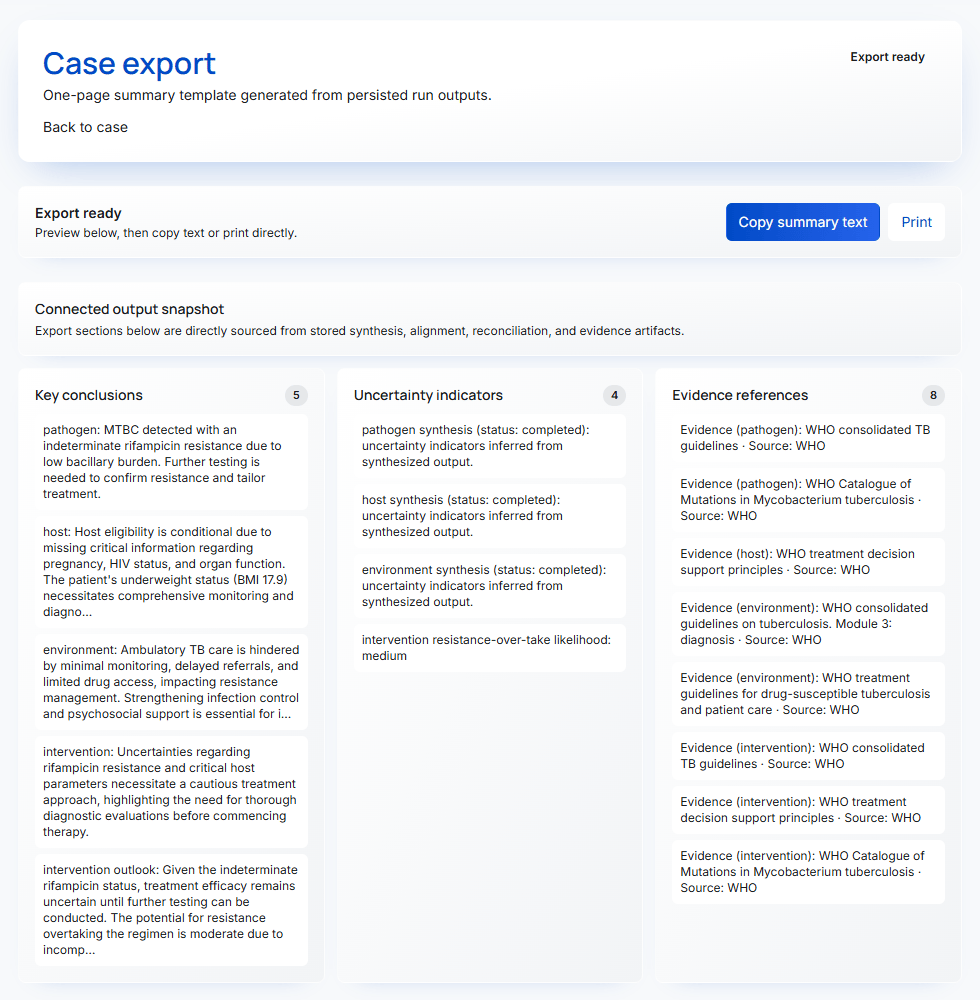
The result is saved as a case with the contribution of each provider, the citations and the confidence. The prompts ask for citations when evidence is available, and in comparative runs a pre-publish check blocks claims without a citation or agent attribution.
Architecture
Case and evidence
A guided five-step wizard turns a tuberculosis case into structured data: pathogen lab results, host profile, care setting and regimen. Each agent also gets evidence: a live Europe PMC literature search (trusted hosts, links checked) plus files the scientist uploads. All demo data is synthetic.
Jump to detail 1Four specialist agents
Pathogen, Host and Environment agents run in parallel, each with its own prompt and output schema. The Intervention agent then reads their merged findings and recommends a regimen with a resistance outlook.
Jump to detail 2Four providers, strict JSON
Each agent runs at the same time on OpenAI, Anthropic, Google Gemini and Ollama Cloud. Every answer must pass a strict JSON schema; if it fails, the validation errors become a repair prompt and the call is retried, up to three attempts.
Jump to detail 3GPT-4o synthesis
GPT-4o merges the provider answers for each agent into one, keeping the agreements, the disagreements and the open questions, with a confidence rationale. The cross-check comes from several models answering the same question.
Jump to detail 4Auditable case
The result is saved as a case with the contribution of each provider, the citations and the confidence. The prompts ask for citations when evidence is available, and in comparative runs a pre-publish check blocks claims without a citation or agent attribution.
Jump to detail 5
Problem
Antimicrobial-resistance (AMR) research moves fast, and the evidence is spread across a large, growing literature. Ask one model about a patient case and you get one answer, with no way to see where models disagree or where the evidence came from. Researchers need the reasoning, the conflicts and the sources laid out so they can check them.
What I built
Aegis is a research decision-support platform for AMR, with tuberculosis as the first disease. A scientist fills a five-step wizard that turns a TB case into structured data: pathogen lab results, host profile, care setting and treatment options. Every demo case is synthetic.
Four specialist agents then analyse the case: Pathogen, Host, Environment and Intervention. The first three run in parallel; Intervention reads their merged findings and recommends a regimen with a resistance outlook. Each agent runs at the same time on OpenAI, Anthropic, Google Gemini and Ollama Cloud. Every answer has to pass a strict JSON schema, and a failed one goes back to the model with the validation errors as a repair prompt. GPT-4o then merges the provider answers for each agent and keeps the agreements, the disagreements and the open questions.
The evidence comes from a live Europe PMC literature search, filtered to trusted hosts with every link checked before the model sees it, plus files the scientist uploads. The prompts ask for citations when evidence is available, and in comparative runs a pre-publish check blocks any claim without a citation or agent attribution. Each case is saved with every provider's contribution, so a reviewer can audit how the answer was built.
My role
I led a three-person team, with Sibylle and Carlos, at the GSK × IE University Biopharma & AI Gateway in Madrid, from January to June 2026. I wrote 102 of the project's 110 commits, including the agent orchestration, the provider adapters, the synthesis step, the literature search and the case wizard. Sibylle built case review, export and the evidence-source registry; Carlos worked on the agent personas and prompts.
Stack
TypeScript, Next.js 15, React 19, tRPC, Prisma and NextAuth, calling the OpenAI, Anthropic, Gemini and Ollama Cloud APIs and the Europe PMC REST API. 484 automated tests, and CI runs lint, typecheck, tests and the build.
Result
Aegis won Best Patient Impact at the GSK × IE Biopharma & AI Gateway. It is a research tool, not a clinical one: the app says so on every stored case, and the demo runs on synthetic cases.